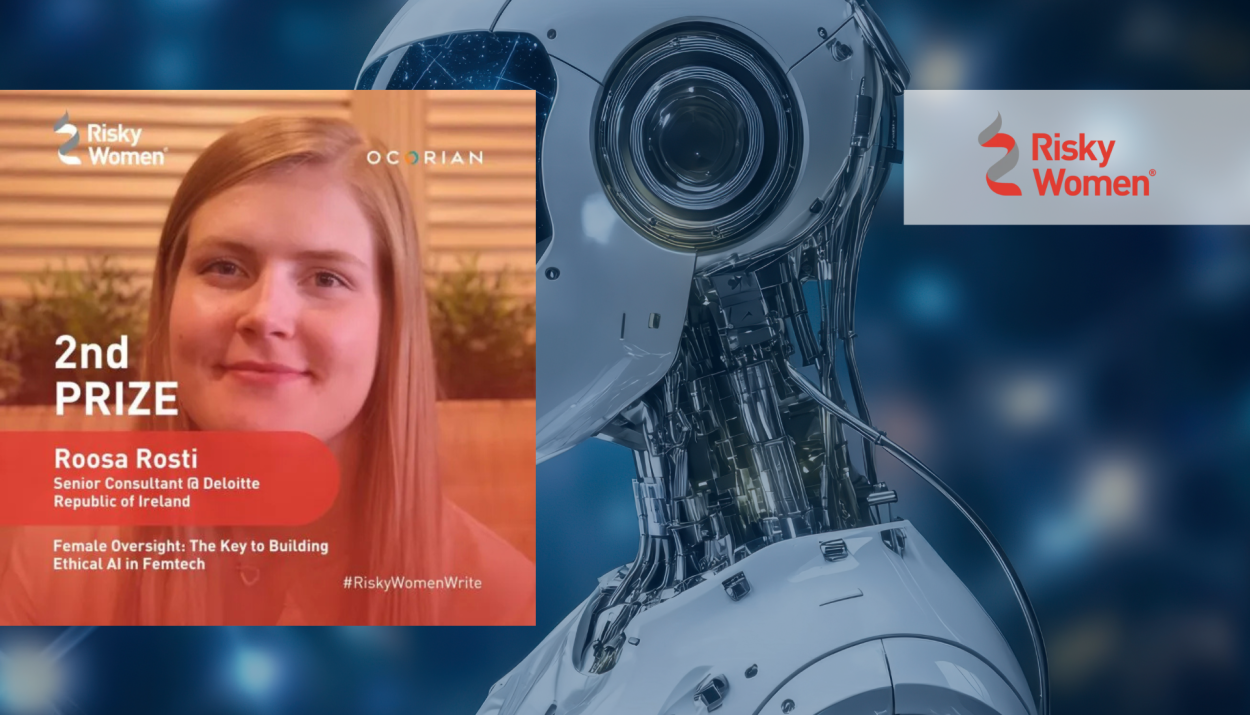

By Roosa Rosti
This article won Second Prize at the 2025 Risky Women Writing Competition, presented in partnership with Ocorian. It was originally published here.
As femtech rises to meet women’s health needs, one can’t help but chuckle at the irony: technology designed to empower women may just reinforce outdated biases. With AI’s promise looming, will we truly transform femtech, or merely dress up the same old disparities in shiny new algorithms?
Technology has long been transforming healthcare and more recently, femtech has begun to address the specific needs of women. The term “femtech” itself refers to technology-enabled products and service designed specifically for women’s health and wellness. This growing technology area ranges from fertility trackers and menopause apps to wearables and diagnostic tools and aims to tackle the issues that have historically been overlooked or dismissed. Femtech represents a shift in power by bringing data and personalised insights directly to women, enabling them to understand and advocate for their health and wellness.
With the introduction of artificial intelligence (“AI”) into femtech, we can expect the potential impact to become even greater. AI can enable predictive modelling, earlier diagnosis, personalised treatment recommendations, and scalable access to care. The recent Femtech in Ireland report identified AI-powered solutions as a high-potential growth area for femtech startups, emphasising how this technology could revolutionise the sector. A question arises however is whether it will really transform femtech or will it entrench what femtech has set out to dismantle.
Progress in femtech is built on a foundation of data, but that foundation is highly flawed. For decades, medical and scientific research has mostly focused on male subjects and often excluded women altogether, citing “biological complexity” as a reason. Even today, gender-disaggregated data is inconsistently collected or analysed. The result is a persistent gender data gap and a critical lack of knowledge about women’s specific health conditions, symptoms, and biological differences. This gap also extends to social determinants, like income, ethnicity, geographic location, and access to care, which also impact health outcomes. These aspects are often missing from current datasets, creating an incomplete view of women’s health experiences.
AI models require to be trained with data and are in general are only as good as the data they are trained on. Algorithms fed with biased or incomplete datasets will inevitably reflect and reinforce those biases. For example, an AI-driven diagnostic tool that has not been assessed on diverse female populations may misinterpret symptoms, leading to misdiagnosis or delayed treatment. In the worst-case scenario, it may exclude entire groups of women, particularly those from marginalised or underserved communities.
This creates a paradox. The technology intended to empower women could inadvertently perpetuate the disparities it was designed to solve. Without intervention, combining all of that with femtech risks embedding gender and social biases more deeply into the digital health infrastructure.
Implementing a governance-by-design approach is essential for any organization developing products or services that include AI. This means building accountability, transparency, and fairness into the product lifecycle from ideation to deployment, rather than treating it as a compliance add-on at the end. In femtech, where the potential for harm is closely linked to historical biases, a more specific mechanism is needed: female oversight.
This new concept goes beyond just involving diverse groups of women in user research – it requires a formal integration of female perspectives as a key part of governance. While standard user testing might check if a fertility app’s interface is easy to use, a formal female oversight process would specifically examine the algorithm to ensure it does not misinterpret data from women with specific health concerns or those underrepresented in the training data. It also includes women as users of the tech and incorporates their feedback into the process.
This approach embeds accountability and fairness from the very start. It shapes product requirements, guides data collection priorities, and validates algorithmic outputs. It creates a continuous feedback loop where biases are actively watched out for, making sure that the technology does not reinforce the very disparities it seeks to address. While this does not exclude male voices, it does shift the influence to make women’s perspectives central to defining what good looks like in femtech.
Focusing on this transforms governance from a reactive role into a key competitive advantage. Since the target market for femtech is mainly women, ensuring female oversight shapes how AI-powered products are designed, validated, and governed. This makes it not only an ethical necessity but also a commercial strategy for building trust and maximizing the sector’s potential.
Us, as women leaders in GRC, are in the unique position to help shape more ethical femtech and ensure implementation of female oversight into the governance-by-design process. Through insisting on inclusive governance frameworks, we can move closer to closing the gender data gap, foster greater consumer trust and unlock the full potential of femtech. Proper governance is not just about risk mitigation, in this trust-sensitive health tech market it will be a competitive edge.
From the Judges
“The article compellingly argues that formal female oversight is essential for ethical, competitive AI-enabled femtech.”
“Whilst I might not agree with every P.O.V. and suggestion, this is exactly why this piece is so good! It’s getting into the heart of a number of questions, representation, perspective, lived experience, governance, data, ethics etc… important areas where more ideas would accelerate collective good. Bravo!!”
“Without intervention, combining all of that with femtech risks embedding gender and social biases more deeply into the digital health infrastructure.”